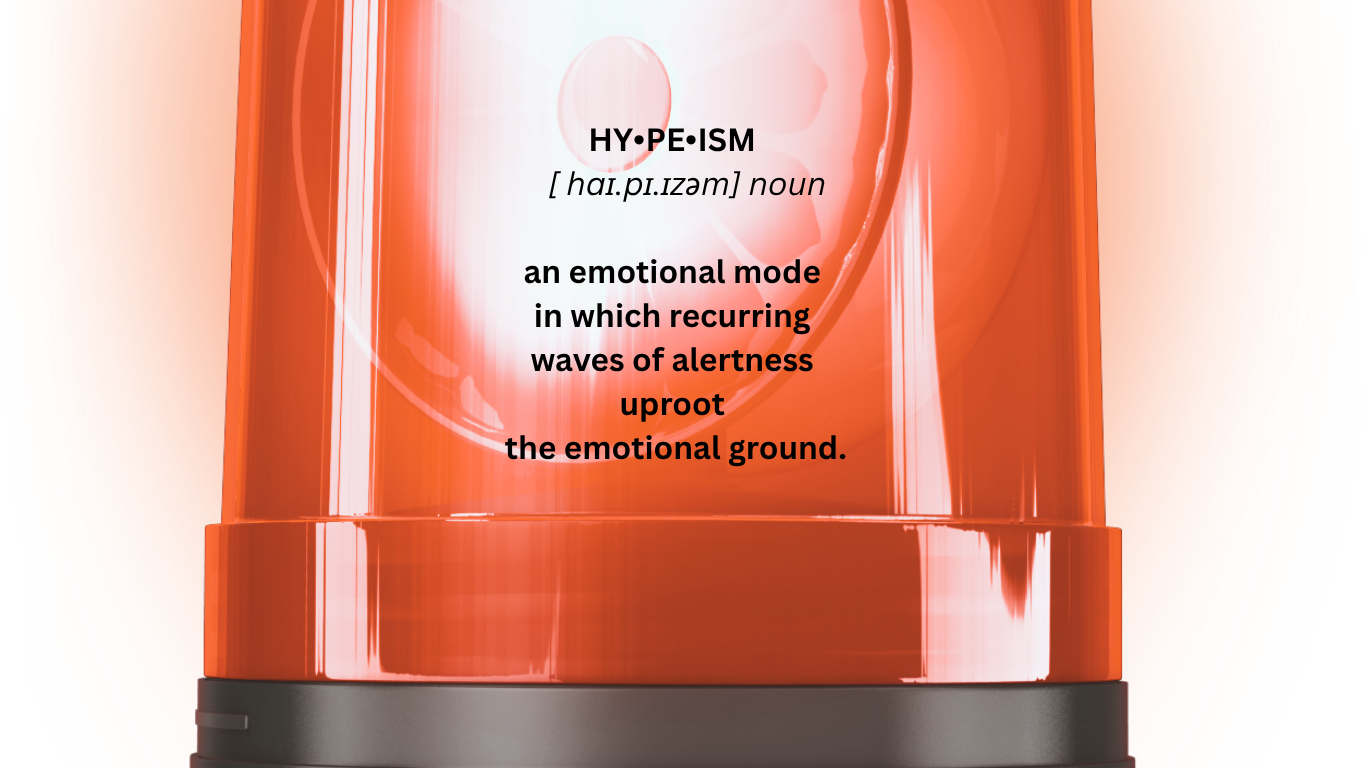
The Creep — How Hypeism Arrives
To hype is human. We need rumour, fuss, anticipation — the small excitements that lubricate social life, that make us feel we are part of something moving. We load things with meaning until they glow. We whisper about what is coming. We gather around the new, the possible, the not-yet. This is not weakness or vanity. It is how we find each other, how we signal that we are still paying attention, how we remind ourselves that the world is not finished yet.
Nobody announced the moment when this tipped.
In public life, it arrives as a knall. A candidate is loaded with everything we want to believe — not just a politician but a signal, a proof, a feeling about the world. He wins. And before I can hold the moment, the machine arrives. The instant take. The processing. Someone explains my own joy away. By the time I close my phone, I cannot find the feeling anymore. The hype needed the fight more than it needed the victory.
In the consumer world, it arrives as a release. A new device I did not know I needed until the need was already installed.
In economic life, it arrives as a shortage. The thing I cannot get becomes the thing I must have. By the time supply returns, I have forgotten why I wanted it — but the wanting trained me, and the training stays.
What makes me stop is this: in all three cases, I did not resist. I did not even hesitate. The machine did not override my feeling — it arrived before I had finished having it. That is the creep. Not force. Perfect timing.
The Concealed — What Makes It Dangerous
Hypeism hollows us out.
It does not announce itself. It does not argue. It simply arrives just ahead of the feeling — and by the time the feeling forms, it has already been processed, packaged, and made ready to share. This is not suppression. It is pre-emption. And pre-emption leaves no wound to point to.
Hypeism does not present itself as a problem. It presents itself as participation. It offers energy. Connection. The feeling of being inside something that matters. It arrives speaking the language of aliveness — and that is precisely what makes it hard to see. You do not suspect the thing that makes you feel more awake.
What turns hype into Hypeism is repetition with intent. Hype is a human impulse. Hypeism is that impulse captured, systematised, and deployed at scale — by platforms that profit from arousal, by brands that need your nervous system more than your judgment, by political actors who require your excitement to remain ungoverned. When the excitement is manufactured often enough, reliably enough, the impulse is no longer yours. It has been trained. And a trained impulse that believes itself to be spontaneous is an ideology.
That is when hype earns its ism.
What it actually does is quieter and takes longer to notice. It does not remove your feelings. It arrives just ahead of them. It processes, frames, and returns them to you in a form that is easier to share — which means a form that has already been approved. The feeling you end up with is not false. It is just no longer fully yours.
This is the concealed mechanism: not suppression but pre-emption. Not too little feeling but feeling that has been handled before it could be felt.
The Operators — Who Uses It and How
I did not figure this out theoretically. I noticed it in myself first.
I noticed it when I stayed on a platform longer than I intended — not because I was enjoying it, but because something kept almost arriving. I noticed it when I bought a thing not because I needed it but because not buying it felt like a statement I did not want to make. I noticed it when a political figure made me feel that my excitement was participation — and that my doubt was betrayal.
That is when I started looking for who benefits from this state.
The platforms profit from arousal. Not from satisfaction, not from information — from the milliseconds my nervous system stays activated. The algorithm does not distinguish between the feeling that enlarges me and the feeling that depletes me. It optimises for duration.
The brands need my identity more than my purchase. The hype is not incidental to the product. The hype is the product. What is sold is the feeling of being early, of being inside, of mattering in the way that consumers are permitted to matter.
The political actors require excitement that remains ungoverned. A mobilised base is useful. A base that has stopped to think is inconvenient.
Three operators. One shared interest: that I remain responsive and do not become reflective.
These operators do not announce their work. They leave traces — recognisable in the room, in the meeting, in the brand statement, long before anyone names what is happening.
Five Emotional Traps. Every Ism Springs Them.
I borrow from psychopathology vocabulary deliberately — not to pathologize individuals, but to sharpen the edge of what is at stake.
These five traps are not a diagnosis checklist. They are the emotional weather of the ism condition — the falling-in-before-you-noticed, the door that closes behind you. They appear across the entire Isms Under Pressure series. Hypeism was the first place I learned to read them. It will not be the last.
How Hypeism Runs the Five.
In Hypeism, they show up like this: the excitement performs before it is felt (Façade Fixation); doubt is read as betrayal, not information (Doubt Denial Reflex); the announcement replaces the product (Grandiosity Spiral); market signals are collected, processed, and set aside (Overconfidence Syndrome); and when the metrics drop twelve percent on a Tuesday, the entire strategy is not revised — it is detonated (Irritability Overflow).
Think of: Excessive Crisis Spin. A company responds to a public failure with over-scripted, cautious statements, avoiding genuine accountability.
Think of: Resistance to Innovation Feedback. A startup refuses to pivot or adjust its flagship product despite market signals because "this is our vision."
Think of: Overpromising Product Capabilities. A startup announces revolutionary features before they exist. The announcement is the product. The feature does not exist yet — but the press release does, the keynote does, the conviction does.
Think of: Product Launch Hubris. A company launches a product believing their innovation is foolproof. The consumer feedback was collected, processed, and set aside. The competitive analysis was commissioned, delivered, and ignored.
Think of: Metrics Triggered Anxiety Spark. Engagement drops by twelve percent on a Tuesday and by Wednesday the entire strategy is on fire. Not revised — detonated.
These are emotional signatures of a system doing exactly what it was designed to do. Recognising them is not enough.
The Damage — When We Are Worse Off
Hypeism does not arrive as collapse. It arrives as a slight dulling — so gradual that I mistake it for maturity.
What I lose first is not the feeling. It is the conflict between feelings. The cocktail of contradictory impulses — wanting and doubting, moved and resistant, hopeful and suspicious — that keeps me alert to my own interior. Hypeism does not flatten the emotions by removing them. It flattens them by removing the friction between them. What remains is a kind of smooth affect: present enough to perform, too even to trust.
I am not numb. I am uncontested.
And that is where judgment goes. The inner compass that tells me what matters, what I actually think — separate from what I am supposed to think — depends on that internal friction. When the cocktail is gone, the compass drifts. I trust the metric more than the instinct. I outsource the signal because I can no longer quite hear my own interference.
Hypeism renders the inner ground slightly uninhabitable — and we keep living on it, adjusting, not quite noticing that we have stopped expecting it to hold.
The Drift — If the Ism Wanders Further
The damage in Station IV is personal. The drift is what happens when I am not alone in it.
When enough people around me carry the uncontested state, something shifts in the room. Not dramatically. Meetings still run. Strategies still land. But nobody says the thing. Not from fear — from a deeper forgetting. They no longer quite know what the thing is. And neither, if I am honest, do I.
I notice it in how I stop expecting depth. But more than that — I notice what I stop expecting of myself. The untidy observation, the thing I half-know but would rather not follow to its conclusion, the feeling that sits badly with the direction we have already chosen. Hypeism gives me permission to be careless with these. Not to suppress them — just to let the current carry them away. The noise is loud enough. Nobody will notice. And if nobody notices, perhaps it was not important.
That is the flimsy relief Hypeism quietly offers: the permission to be imprecise about the things that would cost something to see clearly.
What if the new product actually listened to the market research — not as a box to tick but as a reason to pause? What if the go-to-market strategy measured itself against world-class standards rather than the energy of its own announcement? These are not radical questions. They are the questions that used to be asked before the drift made them feel like disloyalty.
What drifts is the threshold for what counts as real. Announcements replace decisions. Visibility replaces value. And because everyone around me is performing, the question of what is actually happening becomes — awkward. I stop asking it. Not because I was told to. Because asking it started to feel like bad manners.
The Hypeism drift is not a system that forbids the truth. It establishes a climate in which the truth becomes socially expensive — and I, without a single explicit instruction, learn to budget accordingly.
Fool the Ism — A Trick & Care Move
Hypeism cannot be argued out of existence. It is not a position — it is a climate. You do not debate a climate. You seduce it sideways.
The move is not a challenge. It is an invitation so slightly off rhythm that the room leans in before it knows why.
A product launch arrives with its excitement already installed? I do not resist the current. I step just beside it — and ask, lightly, as if genuinely curious: What would have to be true for this to disappoint us in eighteen months?
Nothing is punctured. The enthusiasm is still in the room. But it has been given a task instead of an audience. And a hype that has been handed a task is no longer quite a hype — it is a hypothesis. Something you can work with. Something that can be wrong, which means something that can be right.
The care is what happens next: staying while the question lands. Not withdrawing after the disruption. Holding what arrives when the approved feeling becomes briefly unsustainable. The message underneath, never spoken: your judgment matters more than your enthusiasm. That is a more generous offer than Hypeism ever made.
What Inspires My Thinking
Two thinking companions keep me in Trick & Care mode: Dada pulls me out of solution-finding before the problem has been fully felt; the Caring Trickster laughs at my prejudgments — until they lose their grip.
I think of 1916. Europe is still manufacturing enthusiasm for its own destruction — flags, slogans, a civilisation marching in formation. The Dadaists stepped into a cabaret and made noise that refused to mean anything useful. When the room is loud with manufactured excitement, I do not add my voice to it. I make a different sound — just strange enough that the current briefly loses its grip.
My trickster at work here carries a childlike pleasure-longing — genuinely upset, genuinely hooked, genuinely in the mess. Away from the adult who has filed it all away. Beyond the cynic who swapped the flame for a picture of one. This energy wants to touch the thing itself, not just circling the heat. My reward: Hypeism is stripped naked.
Caution! — Hypeism does not travel alone. It has colleagues, as we know, that share the worst habits. Guess which ism comes next.